Writers' Responses
Although it’s winter in our brains
out on our earth the seasons change.
Branches and nests sit empty and
wait for impossible blossoms to bloom.
Out on our earth the seasons change.
The gate is open. Enter here.
Wait for impossible blossoms to bloom
to open, to reflect, to mirror second nature.
The gate is open. Enter here.
A landing pad for UFOs
opens, reflects, mirrors second nature.
Light streams down from sundogs in a trance.
A landing pad for UFOs,
T-rex recycled out of scraps of DNA,
light streams down from sundogs in a trance
220 kilometers per second.
T-rex recycled out of scraps of DNA,
photosynthesis holds us with compassion,
220 kilometers per second,
opening every petal.
Photosynthesis holds us with compassion,
branches and nests sit empty, then
open every petal
although it’s winter in our brains.
......
Miriam Sagan is the author of over forty books of poetry, prose, and memoir and is the recipient of the City of Santa Fe Mayor’s Award for Excellence in the Arts. She founded and headed the creative writing program at Santa Fe Community College until her retirement in 2016. She now often collaborates with her daughter, photographer Isabel Winson-Sagan, creating text and graphic arts projects under the name “Maternal Mitochondria.” She also gardens and travels with her husband around the country to view and write about outsider art and gardens.
The image of the garden shines through the world of myth. According to the Book of Genesis, the garden was the first humans’ first home, the place where there was no gap between desire and satisfaction. The garden was simultaneously of this world and yet distinctly unworldly, a sphere that offered fruit, beauty, oneness with the divine, and yet enough peril to
doom humankind. It was hardly a coincidence that even before Christopher Columbus first climbed aboard the Santa Maria, there lived in the European imagination a vision of a magical garden, an Arcadia, an earthly paradise, somewhere off to the west. Seventeenth century Puritans and later American frontiersman thought of North America as exactly that. Despite harsh winters and blistering summers, America was the New Garden of Eden. In the 1970s, hippie icons like Joni Mitchell and Crosby, Stills, Nash, and Young would loudly declare that “we are caught in the devil’s bargain” and that “we’ve got to get ourselves back to the garden.”
The garden is, indeed, an integral part of America’s story.
Our Home Gardens: 12 New Mexican Fine Art Photographers, recently on display at the Santa Fe Community College Visual Arts Gallery, adds to this long conversation. It features twelve artists and their visual meditations on their gardens, works that range from the simple and understated to the wild and frantic, some pictures so vibrant they border on the surreal. On one end of the spectrum there is the work of Marilyn Conway, a native of East Orange, New Jersey, who moved to Albuquerque in the 1960s to study fine art at the University of New Mexico. Images like The Garden Gate and Cactus Walk seem to live somewhere between realm of photography and surreal illustration, with streaking, flowing color that is vibrant, other-worldly, and mesmerizing.
Contrasting this is curator Laurie Tümer’s Homebound: Photonic Beam Event I, which captures shafts of light like giant curtains lighting up a green desert landscape. And you have her print, El Parasol don Héctor which shows a studio with exterior walls of scarred corrugated tin against a reddened sky. And Tümer’s Awake to Snow! a photograph of shrubbery and lawn furniture frosted with snow, creates a mood of vivacious silence.And there are others: Nancy Sutor examines the ridges and folds of oyster mushrooms, the long, sleek, and luminescent gills that make the fungi appear almost sentient, while Sondra Goodwin’s print of eggplants becomes something like a nautilus rising against a black background.
The curator's statement notes how during the Covid years, home gardens offered solace when it was in short supply. Tümer’s statement tells us how in the early 2020s, the “The home garden provided therapeutic relief—an accessible, hands-on way to ease stress, restore routine, and nurture life during a period of isolation where over 1.25 million people died . . . ranking it as the deadliest disaster in the country’s history.” This collection of prints pays tribute to that challenging era as it celebrates the humans’ simple, ancient, and necessary connection with the land during a time when isolation was the rule, when life seemed more fragile than usual, and the earth itself seemed to be telling us that “we got to get ourselves back to the garden.”
.......
Albuquerque native Eddie Tafoya is a novelist, a non-fiction writer, and a comedy scholar, and was recently featured in the A&E docuseries The Right to Offend: The Black Comedy Revolution. His book, The Marxist Revolution: How Chico, Harpo, Groucho, and Zeppo Changed the America Laughs, will be released in 2026. Titles of his other books include Legacy of the Wisecrack, Icons of African American Comedy, and Finding the Buddha: A Dark Story of Genius, Griendship and Stand-Up Comedy. He has also worked as a stand-up comedian and his students (he is a retired university literature professor) affectionally referred to him as the Professor of Comedy.
El Niño gave us enough snow and rain
to germinate the feral larkspur seeds
that skipped last year. Must think: their lapis needs
some gold for contrast.
The beeblossoms I brought
in from the empty lot have too-free rein;
they’re crowding the red-whiskered clammyweeds.
I’ll have to pull some, though I like their white
flowers on wiry stems, which I first thought
lacked one petal. I looked again: it’s plain
they’re shaped like butterflies.
I’m glad I chose
to spare the seed-eating ants that sting and bite,
build foot-high, scorched-earth hills. They taught
a friend a lesson. She used bait to kill
hers off; her dogs got ticks.
I drag the hose
on dirt I’ve tramped into paths, hoping there might
be gypsum scorpion flowers coming where
I left seeds from that friend’s yard, but there’s still
nothing. At least my one datura grows—
the flower made of milk that soon goes sour
in sun.
A passerby now stops to stare
and tell me in good Spanglish that he will
help with weeding. People don’t get this style
of landscape. Wonder what he’d want an hour.
My neighbor’s yard could use even more care,
littered with goatheads, brimming with the vile
mustard I pull each spring, plus (now I smile)
two stray larkspurs—and a scorpion flower.
.......
Jerry Friedman teaches physics and math at Santa Fe Community College. He used to have a wild garden, but now sends vines up the stair railing and pillar of his apartment building. He also participates in "citizen science" reporting bird counts, wildflower and insect sightings, and such for conservation data, and leads the occasional birding trip. His poetry, including translations from the Spanish poet Antonio Machado, has appeared in various journals. “The Managed Wild Garden in New Mexico” was first published in Rat’s Ass Review.
Our Home Gardens:12 New Mexico Fine Art Photographers, curated by photographer and educator Laurie Tümer, celebrates the idiosyncratic relationship between photographers and their gardens, applying their knowledge of light, chemistry and the immediacy of the moment to the ground at their feet. In the quirky and intimate views of what can be done with dirt if we start playing in it we meet the adult child behind the lens, the one you might have met in the sandbox when life was one big experiment unburdened by expectations.
What’s missing from the online how-to-garden searches and seed packet instructions is the alchemy that takes place when the Garden becomes gardening and plants and people twine together.
Just as the heavy frost ends the harvest and begins the feast, it was the wind of change that planted photographer Nancy Sutor, who lives in Agua Fria Village, into new fertile ground. While working as a professor of photography at the College of Santa Fe, Sutor felt the push and pull of time demands between her garden, studio practice and her career. When the job ended, she decided to plant herself at home. “I made a rule that I would only photograph within the boundaries of my property. I started with my compost pile. It was my ah-ha moment; it’s all connected,” recalled Sutor while walking through the exhibition. Included are her archival pigment prints of plants unfolding into colorful patterns in her Second Nature series, mysterious reminders of our internal landscapes as we cycle, reset and reflect through the seasons of life. The views of her studio through the four seasons, from full bloom to buried in snow, reminds me I’m part of the circle.I enjoyed Isabel Winson-Sagan’s erotic close-ups of spiny plants and a figure lounging in a field--a threatening exotic pleasure in my sticker ridden New Mexico home.
I feel simultaneously sheltered and soaked by the deluge in Janet Russek’s Rain photographs and nostalgia when I see the passive solar adobe house and playful sculpture garden in Steve Fitch’s documentation of the Waldo homestead recalling the 1970’s optimism for solar power and our current ‘’drill baby drill’’ environment.
The garden becomes serious play in Sondra Goodwin’s stunningly formal archival pigment print titled ‘Eggplant’. This is the Versailles garden version of the exhibition; I want to call it ‘Aubergine’. In a nearby glass case, we get another glimpse of Goodwin’s garden in the ‘And then there was that one time’ series of informal printouts from her social media posts. The captions “And then there was this this one time time I played with my food’ made me laugh. How better to describe the fallen apricots carefully tracing the grout lines on the flagstone patio into an edible mosaic? And the stuffed lounge chairs lined up like a small crop on their way to Mexico where they will be upcycled for life in new homes expanding the cross-border exchange of nurturance.
Tümer’s tender images of gourds in her ‘Cultivated Subjects’ series of digitized Polaroid Transfers reveals the care that permeates her curation. She describes her obsession with the gourds, which she grew each summer between 2000-2006, from seed germination to training them to climb and then rescuing them from a frost.
In the exhibition’s accompanying essay, Tümer says it all: "In our gardens and art making, we practice hope, patience, tenacity and joy--exercising capacities that have always been critical for human survival." We need more of this in the world.
.......
Kathleen McCloud is a painter, printmaker, writer and fiber enthusiast. She shares an acre of dirt in La Cieneguilla, New Mexico with Japanese indigo, chamisa, maximilian sunflowers and many more. Her home of 35 years is a source of endless inspiration, from the beavers in the lower Santa Fe river to the redwing blackbirds in the cottonwoods. Her artwork can be seen at GFContemporary Gallery or contact her for a studio visit via her website. She welcomes collaborations.
I.
A garden is a lot like a photograph. A gardener selects from the random circumstances of location and wild nature the features that please her, that feed her, that challenge her to think, to work so hard to gain a measure of control over her environment. In a garden we put a frame around space, we claim it like the photographer claims the space within her viewfinder, with walls and fences, and we gather shapes and colors and fruits to our liking, arranging them in our garden like the gaudy baubles in a magpie’s nest.
Crisp stone borders, a melting wooden fence (digitally enhanced), hedges containing garden space or no boundary at all, wide open to the desert. Dried up weeds or tall yellow flowers swaying in the afternoon breeze, bounteous harvests of food, flower petals and dead leaves curling at their edges. Metal dinosaurs.
Every element in the garden tells us something about the gardener, as every element in a photograph tells us something about the photographer. We see what they want us to see, amid their chosen elements and their arrangements, the inclusions and the exclusions, we see them, we see them how they want us to see them.
And sometimes we see ourselves too.
II.
I saw myself turning that dark soil, digging in my amendments with love. It’s my favorite part of making a garden. But then I also like the sunshine blast of a fresh cherry tomato, so I’m salivating at pictures of the harvest, and I can taste the crunchy green in a picture of a kale leaf, purple eggplants make me want to go fire up my barbecue. Going deep into the cave of a peony activates my history as a flower farmer, and the bittersweet prospect of inevitable death and desiccation, leaves that once held so much promise and green, that made blessed shade in the heat of summer, now lie dry and curled on the ground, exhausted rinds of fruit piled up in the compost, the golden stems of dried out plants poke through snow, the ghostly shape of the gardener picking apples, remind me of the futility of investing too much hope in my garden….. until spring, when the fantasy of eternal life begins anew.
III.
My career as a gardener got me into trouble early, as I became fixated on growing illicit shrubs along with my double-dug beds of vegetables at high elevation in the mountains of northern New Mexico. Later in life my family lured me into a Sisyphean stint of running the family farm, eight years before the plow growing organic produce and flowers on forty acres in California, trying to make it make economic sense. I used to drive a fourteen-foot box truckload of flowers in five-gallon buckets, as many as fifty buckets of bunched flowers and floral greens, to the wholesale flower market in San Francisco and try to sell them to cranky, overworked, underpaid florists in the wee hours. And we had a farmstand in a big red turn of the century dairy barn where we sold our produce (still do, check it out: oakhillfarm.net), and packrat shit fell from the ceiling (it still does, a little bit).
IV.
I still count as my greatest vegetable accomplishment from my life of growing things the winter harvest Kuroda Chantenay carrots I grew in El Rito, NM in the 1980s. Not only were they the most delicious carrots ever, but the pleasure of going outside on a freezing December day, sweeping the snow off the mounds of protective straw and then peeling back the straw to reveal unfrozen garden soil and the orange heads of my carrot crop. I called that beautiful sandy loamy soil in that place “The Belly Button of the Carrot Goddess.” In winter it smelled marvelous.
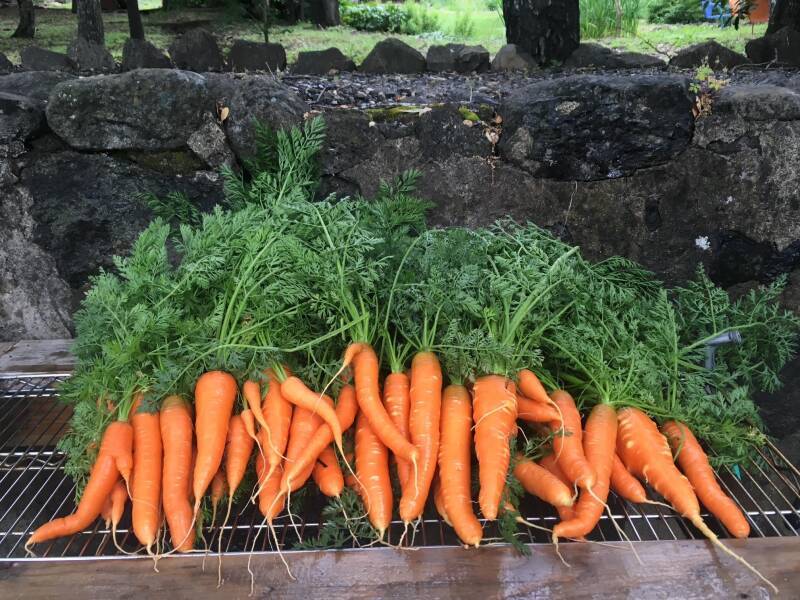
Ted Bucklin grew up in a horticultural household in northern California and his mother raised him and his siblings preparing delicious foods that came from plants they grew. They always had gardens planted for beauty and for food, and all worked together in the gardens. He still thrills at the anticipation of a fresh lemon cucumber or a dirt-rimed carrot just pulled from the earth, as he did when he was young. When his mother died in 2019, she handed the farm over to his sisters. He and his brother ended up with the vineyard across the highway. His brother makes wine (buckzin.com). His sisters are farming; to help them, their stroke of genius was to hire a real farmer (and her farmer husband) who grew up in New Mexico, the child of hippie vegetable garden parents, Ted's daughter Melissa.
Our gardens, and the wonderful gardens from the exhibition Our Home Gardens, are personal connections with nature; a sanctuary—a place for rest and thought; and a place of artistic inspiration. Congratulations to all involved with the creation of Our Home Gardens.
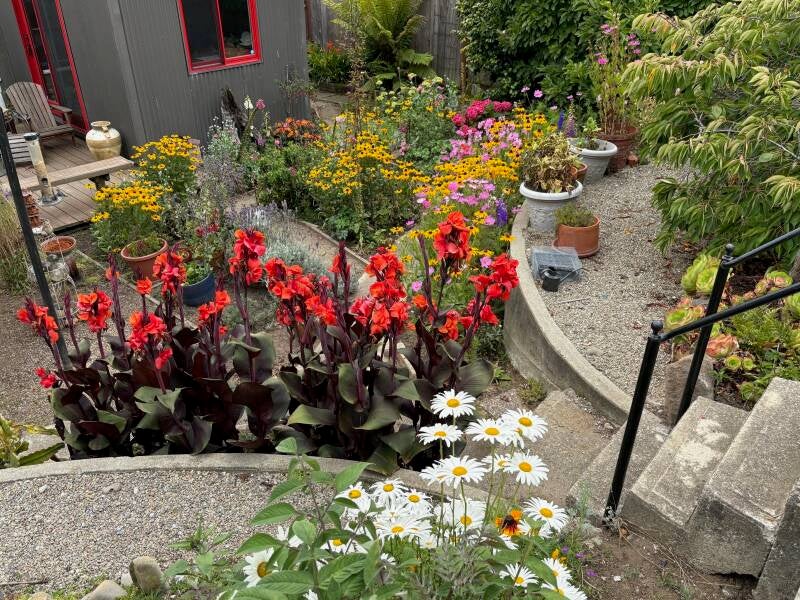
I have been gardening for many years and my start came from my father and his love of roses. When we purchased our home, (my childhood home from my parents), my father provided advice on: placement, planting, pruning, and fertilizing. A garden’s power to connect us to others can not be overstated. Certain plants bring certain people to mind—that’s part of the magic of a garden. My front yard is a formal rose garden that is a favorite of our neighbors and melds my aesthetic with my father’s. When I prune my roses (in what was once my father’s garden), I always reconnect with him even though he left us twenty years ago. There are other people connected to my garden in a similar way and that makes a walk through the garden quite special.
Over time I have become intrigued with gardening from seed. I find great satisfaction watching seeds sprout, generate their true leaves and then grow into an enormous plant covered with beautiful flowers—it seems to be magic. A slow-motion magic trick extended over many months. Each year my back garden is an experiment. What seeds do I scatter this year and how will they combine with the self-seeding from last year’s garden? I like the element of surprise it provides. Gardening from seed also makes the garden extremely malleable. If too many plants appear in one area, I can easily move some to maintain a desired balance. You can also share your extras with other gardeners. That puts you into their garden! I find that a very satisfying part of gardening.
The cycle continues when I collect seeds from spent flowers for next year’s garden or to share with others. I find the collecting of seeds very therapeutic. When you consider the physical energy stored within the tiniest of seeds it is mind-boggling. All winter long I am waiting for their return and walk the garden looking for any sign of new life.
Lyle Gomes began photographing seriously at the age of twenty and received his B.A. (1978) and M.A. (1980) in Art from San Francisco State University. During the summers of 1978-1980 he worked as an assistant for the Ansel Adams Yosemite Workshops. He is a recipient of a Fulbright Scholar Award (Britain) and a Rockefeller Foundation residency (Bellagio, Italy). In 2005, the University of Virginia Press published his long-term project, Imagining Eden: Connecting Landscapes. The book includes sixty photographs made from locations in America and Europe—primarily city parks and gardens. These imaginative places were created as an attempt at recovering a connection with nature lost with Eden. He served as head of the photography program at College of San Mateo for over thirty years and retired from teaching in 2015.